Beyond Fixing – The Therapeutic Value of Being Heard
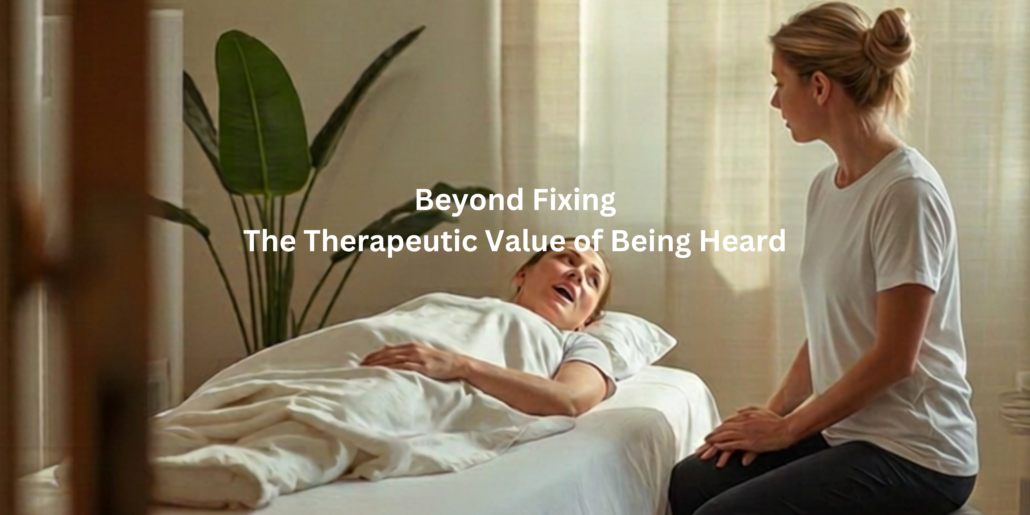
Therapeutic listening, the elephant in most treatment rooms, and it’s not the patient’s pain.
It’s us.
RMTs and Acupuncturists are trained to solve human movement and functioning issues. To find out what’s happening, build a plan for treatment and provide some targeted exercise, movement, diet or other related advice. That’s the job, and most of us are good at it. We take it seriously and our practices are what we have to show for it. The elephant arrives when someone gets on the table for shoulder pain and ends up telling you about their marriage falling apart, or a parent with dementia, or a job they hate, or a grief they haven’t fully processed among just a few. TMI (even though its not ) in the treatment room is a real thing and how we respond to it makes a difference.
And in that moment, the “fixer” elephant instinct often kicks in whether you invited it or not.
Have you tried… What if you… You should… I had something similar… I think what you need…
Sometimes those instincts are exactly right. Other times, they miss the mark. Often, the person on your table isn’t asking you to solve anything. They’re asking you to be someone who simply listens without withdrawing or redirecting while they say the hard things out loud.
We are trained to guide the body toward change, and we measure success by what happens after the appointment. When a patient follows through with their home care and returns feeling better, it confirms that the process worked. Those success stories are the easy ones.
But, sometimes people don’t come back because it’s getting better. They come back again and again when it’s not better and despite your best supportive efforts they haven’t done anything about it beyond the session.
Then comes the harder question. Is the patient ready to engage in the process? Are they willing to make the changes that support healing, or are they relying on the treatment alone to undo the effects of the habits, stress, and demands that continue every day?
We are seeing this challenge more often. Recovery is not only physical. It is deeply influenced by motivation, mindset, and a person’s ability to take an active role in their own care.
Why Therapeutic Listening Is Part of Treatment
There is a common belief in our profession that listening is simply what happens before the treatment begins. It is viewed as the intake, the fact finding, or the conversation that takes place before our hands ever touch the patient.
Yet many experienced practitioners come to realize that some of the most important information emerges during the treatment itself. As patients begin to relax, their stories, beliefs, fears, and patterns often surface. These conversations can reveal not only what the problem is, but sometimes, more importantly, what it is not.
Therapeutic listening has the potential to influence the nervous system. When a person feels genuinely heard, their breathing often changes, their muscles begin to soften, and their protective responses can lessen. The tissues beneath our hands may respond differently, not because we are doing more, but because the person no longer feels the need to hold on quite so tightly.
Although it may appear passive, listening is an active clinical skill. It creates safety, builds trust, and can become an important part of comprehensive care.
When Patients Are Not Ready for Change
The harder truth, and one many experienced therapists learn through experience, is that you cannot want someone to change more than they want it themselves. You can prescribe the exercises, recommend lifestyle changes, suggest a referral, and create a thoughtful treatment plan, yet still see that person return a month later having done none of it, sharing the same story once again.
Sometimes they apologize for not following through. More often than not, they are already carrying enough guilt and frustration without feeling they have disappointed their therapist as well. Our role is not to judge or carry that burden for them. It is to continue offering guidance, support, and opportunities for change when they are ready to take the next step.
That’s not a failure of your advice. Readiness isn’t something you can hand someone. It’s something they arrive at, usually after they’ve felt safe enough to actually look at what’s going on.
Home Care That Matches Patient Readiness
Give home care. Always. But fit it to the person in front of you, to the life they actually have right now, not the life you wish they had room for.
Sometimes it is five minutes at the end of a treatment. A few slower breaths together while you provide support and help the person reconnect with their own body. Diaphragm releases (craniosacral technique) can be a valuable part of this process, as can simple guidance such as, “notice your breathing while I support you.”
When everything else feels overwhelming, a few intentional moments to pause, settle, and reconnect can be meaningful.
Does that sound a little uncomfortable or even corny? Maybe. But sometimes the things that feel unfamiliar are the very things that create the most meaningful shifts in the therapeutic relationship.
Completing the Session with Intention
Sometimes the most meaningful home care isn’t an exercise or a set of instructions at all. Sometimes it is offering a glass of water. Sitting quietly together for a moment. Walking someone to the waiting room or all the way to the front door instead of simply pointing the way. Looking them in the eye and sincerely hoping the rest of their day, or night, goes well.
These small gestures may seem insignificant, yet they remind people they have been cared for, not just treated. Sometimes that is exactly what they need to take with them.
That’s still care. It’s just not advice.
Therapeutic Listening Helps Reduce Burnout
Listening is not easy for a fixer. It is not easy for a confident, therapeutically oriented practitioner who has developed the skills and knowledge to help solve a wide variety of problems. For many of us in this profession, that instinct to help is exactly what brought us here.
But some people do not need to be fixed in that moment. They need to be heard and given space and someone who can meet them where they are, rather than trying to move them forward before they are ready.
If we continually try to create change on our timeline instead of theirs, this population can become one of the most exhausting parts of our work. Listening, patience, and radical acceptance may become some of our most valuable tools.
Acceptance does not mean giving up on someone. It means recognizing where they are today, without judgment, and creating the safety that allows change to happen when they are ready.
This is not really about the patient who takes your best advice, makes changes, and never comes back. It is about the person who continues to return, but does not engage with the resources you offer, avoids the conversation when you ask about home care, or becomes vague when you ask whether anything has changed or improved.
These are often the patients who challenge us the most. Not because they are difficult, but because they remind us that providing care and creating change are two different things. Our role is to offer guidance, support, and expertise, but lasting change requires participation from the person receiving the care.
We are not trained counsellors, and even within counselling, there is often a balance between understanding, supporting, and helping someone move toward change. Yet the world around us is constantly pushing solutions. Social media alone can provide someone with ten answers before breakfast.
Against that backdrop, simply listening can appear like doing nothing. It can feel as though nothing is happening at all.
Therapeutic listening is not passive. When someone feels genuinely heard, they often feel safer, more understood, and less alone in their experience. That can create the space for them to better understand what they need, what they are ready for, and what steps they may be willing to take next.
Sometimes the most valuable thing we can offer is not another solution, but the experience of being cared for while they find their own capacity for change.
Try it anyway. Let’s surprise ourselves with this modality.
Putting Therapeutic Listening Into Practice
Not much changes in the mechanics of your day. You still assess. Treatment still happens. Home care is still provided in whatever form is appropriate.
The shift is smaller and harder to measure. It is learning to recognize the difference between a patient who wants a plan and a patient who, in that moment, needs to be heard. It is allowing that person to be where they are without labeling them as non-compliant or believing you have failed to help them.
Sometimes the most clinically valuable thing you offer in an hour is not the intervention itself. Sometimes it is that you did not rush past the part of them that needed to be heard first.